
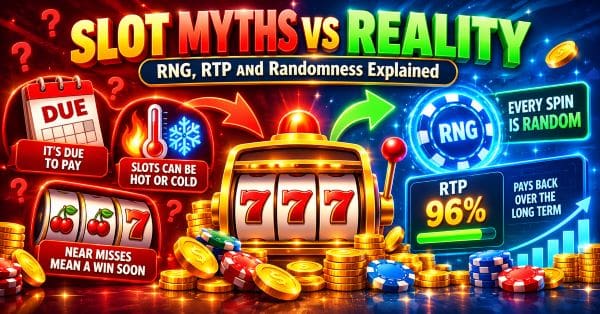
The fact that many slot machine myths are based on a true understanding of how the games operate can help you better evaluate what is fact versus fiction. Each certified slot machine operates using a random number generator. A PRNG is used to create a series of seemingly random numbers, either continually or depending on player activity. When a player presses the “spin” button, the game uses the next number(s) generated in the stream to determine which symbols landed on the reels, whether a bonus is triggered, and the multiplier. However, the mapping of these random numbers to an outcome is called the game’s mathematics. As such, each developer designs the reels, the pay table, the bonus odds, and the resultant RTP for their game.
Then, a testing laboratory verifies that the RNG is truly random and that the game pays out as claimed over the long term. Testing laboratories like ecogra, itech labs, and gaming laboratories international (GLI), provide this service. In addition, many of these testing laboratories are accredited by ISO/IEC 17025, which is the global standard for testing and calibration laboratories. For regulated online gaming operators, they are usually required to only utilize games that were tested and approved by an accredited laboratory prior to being allowed to launch in a jurisdiction. The final piece of information that helps kill off many of these myths is simple; each spin of a slot is an independent event. The RNG does not keep track of your session, your losses, the last jackpot hit or the time of day. All it generates is the next number.
Myth #1 – slot machines are due after a long losing streak
This is perhaps the oldest of all the slot machine myths and it clearly represents a classic case of the gambler’s fallacy. This fallacy occurs when a person believes that past independent events impact future events. If you toss a coin ten times consecutively and it lands on its head each time, landing on tails on the eleventh flip is not more likely than it would have been on the tenth flip. The exact same principle applies to slot machines. Is a slot machine due for a payout? Absolutely not. A slot machine that goes 200 consecutive spins without a significant win has absolutely no greater chance of paying out on spin 201 than it did on spin 1.
Will a slot machine ever remember previous spins? No. There is no counter tracking down to when you receive your reward. Why do people think this way? It’s quite obvious – the longer you go without getting rewarded, the longer you are waiting for the machine to balance out your losses. However, the game does not correct itself in order to achieve the long-term average RTP. Instead, it achieves this average through sheer volume. A long losing streak is simply diluted across thousands upon thousands of other plays by all other players. Simply stated, the machine never owed you anything.
Myth #2 – slot machines run hot/cold
Will slot machines exhibit hot and cold streaks? Yes, certainly. A machine may produce three bonus wins within twenty minutes and then be silent for an hour. Will you ever detect and take advantage of a hot/cold condition existing inside a machine? Never.
Slot machine streaks are simply examples of statistical variance in action. Random sequences tend to be clumpy compared to expectations. When asked to write down a “random” sequence of 100 coin flips, virtually all individuals will avoid creating long runs of heads or tails while true random sequences consistently include runs of six or seven. Similarly, slot machines display similar characteristics. Clusters of wins and prolonged dry spells occur frequently in both natural and manufactured randomness. Unfortunately, confirmation bias steps in here and makes people selectively remember certain instances (the night the machine at the bar went wild). While people commonly recall this instance, they forget that eleven other nights at the same machine resulted in steady losses.
Myth #3 – a slot machine is cold after paying out big
Similar to myth #1 – if a player sees another player cash in a large jackpot and assumes that the slot has “paid out”, therefore the machine will now be “tight” for a while to replenish its funds. Do slot machines pay less after a jackpot? Absolutely not. And do slot machines pay more after a large win? Once again – absolutely not. The next spin after a jackpot has the same inherent probability as any other spin. The winnings from a jackpot do not come from a tank that needs to be filled. Jackpot payouts are funded solely by the game’s overall math over all play, and progressive jackpot resets to a seed amount and begins growing again, however, the odds of triggering a progressive on the next spin do not decrease because someone just won.
Myth #4 – casinos can change RTP during play
Can casinos adjust RTP mid-session? This question requires a bit of caution since there is an element of truth here that has grown far beyond reasonable proportions. Certified games have fixed RTP values embedded into their math models. Licensed operators cannot manually alter RTP values mid-session to favor you because you are winning too much. However, what is true is that many certified games are released in multiple versions. For example, an online slot may be offered at 96%, 94%, or even lower RTP rates depending on which version an operator chooses to release. This is referred to as variable RTP (as referenced below) and explains why two casinos offering the same game may publish different RTP rates for that game.
This decision is made when configuring the game and not while you are actively spinning. On the land-based side, some jurisdictions permit server-based machines to be altered remotely; however, most regulators mandate that such alterations be documented and that such alteration(s) occur while the machine is not in active play. Changes to the core math models typically require operator approval and recertification. One important note: be sure to check the game help / info screen. Many regulated online sites list the currently active rtp rate version being utilized for that particular title. If Two casinos offer the same title with different published rtp rates – that difference is real and worth your attention.
Myth #5 – higher bets improve my odds
Do bet sizes impact slot odds? Generally speaking – no! In most modern video slots (with few exceptions), regardless of your bet size – whether it is 20 cents or 20 dollars – winning combinations will pay out the same amount for each stake level. Larger bets increase winnings and losses simultaneously. Probability remains the same regardless of bet size. Does betting max increase my chance to win big? Ahh — now we have an old piece of advice that originated from classic land-based slots! Back in those days, some classic slots would have a much larger top award when betting max coins vs betting min coins. Therefore – although not pure superstition on those classics – betting max coins was indeed slightly more advantageous in terms of overall RTP @ max bet.
Myth #6 – stopping reels improves my chances
Is stopping reels at exact timing improving my chances? It feels like it should! You hit spin – the reels snap to place – and you feel like you timed it perfectly to impact the results! You didnt! Stopping reels only animates the final result that already exists at the moment of initialization of the spin. Quick spin/turbo modes only change how fast you see the final result – not what the final result will be!
Myth #7 – best time to play?
Do slot machines pay more at night? Weekends? Tuesdays at 3 am when the floor is empty? The “best time to play slots” myth has localized versions galore. Time of day does not impact certified RNG slot machines from paying or not paying! The generator does not read the clock! Any reason you may think wins happen more often than loses on busy saturdays nights is because there are more people playing – therefore totally more wins occur overall! Individual odds per spin remain identical regardless of when you play! Practical considerations alone matter: playing when fatigued/dinking/frustrated makes decisions poorer. This has nothing to do with machine and everything to do with you!
Myth #8 – a machine left by another player was ready to pay!
Have you ever seen this one in action?! Someone loses steadily for an hour — walks away — and another person slides into the seat like they found a winning lottery ticket lying on the sidewalk! Next player receives no favorable condition from previous players session — since spins are independent events — hours of losses before you sat down have zero effect on first spin. Conversely — if you walk away & someone hits a big win on “your” machine five minutes later — you didnt miss anything! They hit a specific RNG value at a specific millisecond — had you stayed — you would’ve pressed spin at a different moment — got a completely new number!
Myth #9 – near misses means big win is close
Did you get Two jackpot symbols on the reel — with the third symbol slightly above the pay line?! Do these near misses mean a win is coming?! Absolutely not! Near misses are visual results — not indicators that next spin will win! There is something interesting about how powerfully near misses influence behavior — gambling psychology researchers have shown that near misses feel closer to a win than they feel close to a loss — which encourages players to continue to play further! Designers know this & many regulators restrict designs that artificially inflate the frequency of near misses! Fair/random/independent certified games display near misses solely as one of many losing results that looks dramatic.
Myth #10 – a 96% RTP slot returns 96% every session!
Does 96% RTP mean you win 96% of spins?! Or does it mean you’ll return $96 out of every $100 played tonight?! Neither — and perhaps the most misunderstood statistic in all of slots is RTP — specifically in terms of how it is calculated. RTP represents a long-term statistical average across a very large number of spins — typically millions or more! What RTP tells us is the expected value of the game across those millions/billions of plays — on a 96% RTP slot — the house edge is 4% — meaning the house keeps approximately 4 cents off of every dollar played by all players across all sessions!
FAQs
Are slots random?
Yes. They are all based upon a certified random number generator (RNG) which determines each possible outcome. In addition, they must be tested by independent laboratories to prove their randomness and conformity with the rules of the game.
Do slot machines have memory?
No. Because each spin is independent from the one before it, they cannot remember past loses, previous players or what the previous jack pot was, as to decide the next spin.
Will a slot machine win next?
No. This is called the gambler’s fallacy. Just like how long losing streaks don’t increase the chances of a win on the next spin, neither does a long winning streak decrease them.
Do hot & cold slots exist?
Because of variance, yes. But they aren’t “hot” or “cold”. And since the machine is designed to operate randomly, you’ll never know whether it is “due” for a win.
Can casinos change slot payout instantly?
In theory, no. Licensed casinos using games that were certified by third-party testing organizations have to follow the same rules as everybody else. While some games may come in different certified return to player (RTP) versions that casino operators can select among, the payout structure can’t be changed while a player is actively playing because they are winning. However, as stated earlier, some older slots and progressive games award bigger prizes to higher bets. If this is true, then it should say so on the pay table.
Does bet size matter on slot odds?
For most modern slot machines, no. For most modern slot machines, increasing your bet size simply increases both your maximum potential win and your maximum potential loss. There are exceptions however. Some older machines and many progressive slots are configured to reward larger bets. These types of games will indicate this on the pay table.